

Best IMS Core Network Solutions for Next-Gen Telecom
2026-08-22
The race to deliver seamless, high-quality voice and data services over 4G/5G networks has made the IP Multimedia Subsystem (IMS) more critical than ever. Yet many operators still struggle with legacy cores that can’t scale or adapt. That’s where IPLOOK steps in — offering a fresh, agile approach to IMS core solutions built for next-gen telecom demands. In this blog, we’ll break down what makes a truly future-ready IMS core, and why IPLOOK’s innovative platform is turning heads across the industry. Get ready to rethink how your network can evolve.
Cloud-Native IMS Core Powers 5G Voice Services
Moving voice services to a cloud-native IMS core changes more than just where the software runs. The old monolithic call control stacks are broken into independently deployable microservices, each handling session control, media resource functions, or subscriber data. This lets operators scale signaling and media planes separately, spin up new instances during sudden traffic spikes, and roll out updates without taking the whole voice network offline.
For 5G, that flexibility translates directly into more resilient VoNR deployments. A cloud-native IMS core can run across multiple availability zones, automatically restart failed components, and rebalance workloads in real time. Because the core is designed around stateless network functions and shared data stores, active calls survive infrastructure failures that would have dropped sessions on older appliances.
The payoffs are also operational. Continuous integration and GitOps-style delivery pipelines fit naturally into a containerized IMS, so new features like emergency call routing or voice over Wi-Fi handover can be tested and deployed in days rather than months. As operators build out network slicing for enterprise voice or push voice functions closer to the edge, a cloud-native core gives them the abstraction and automation needed to keep call quality high without multiplying operational overhead.
Redefining VoLTE Reliability with a Resilient IMS Core
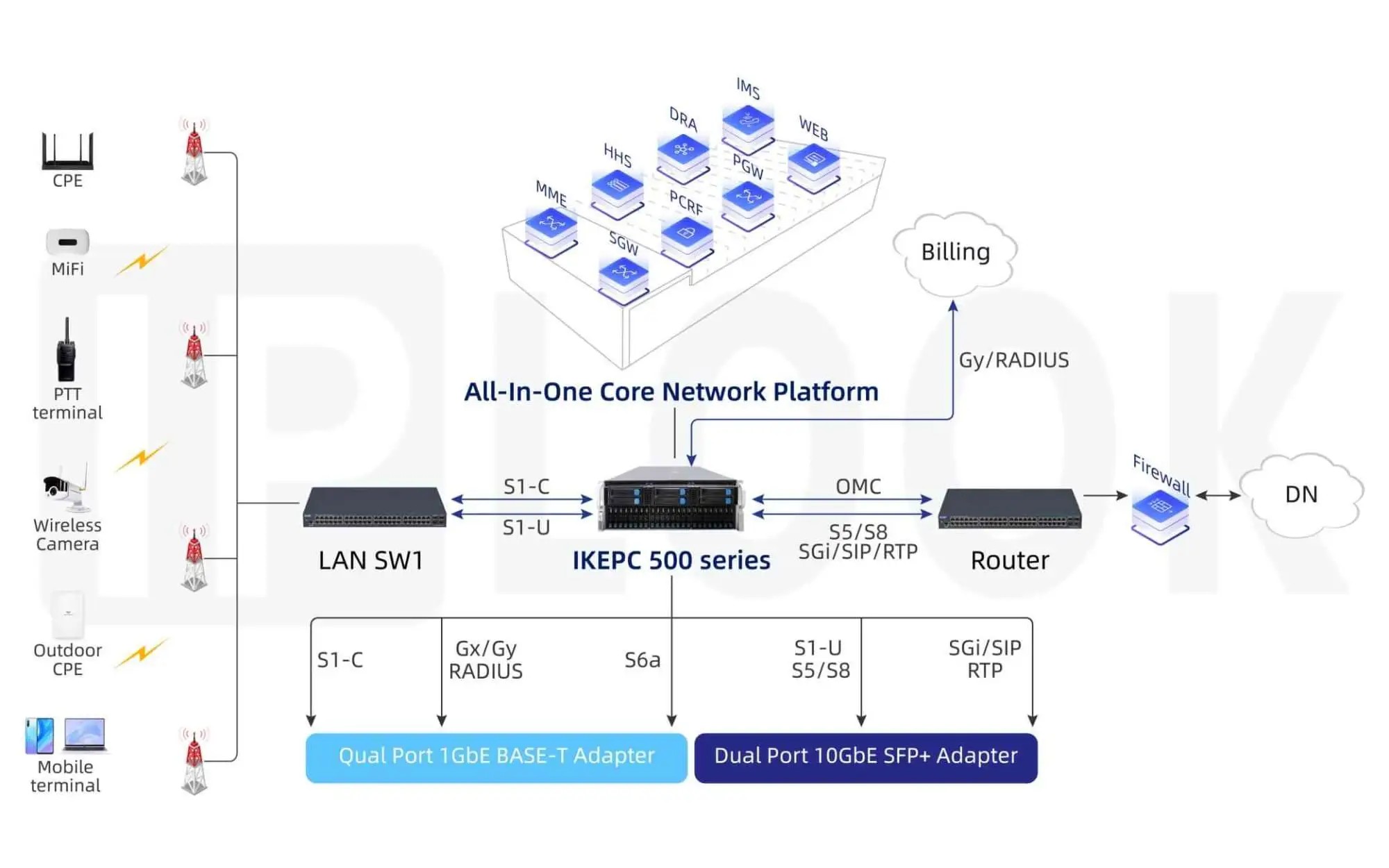
The shift to VoLTE promised clearer calls and faster connections, but without a rock-solid IMS layer, those promises fall apart under real-world pressure. A resilient IMS core doesn't just add redundancy—it rewires how the network absorbs faults, reroutes sessions, and keeps voice services alive when individual nodes misbehave. Instead of treating failures as rare exceptions, this approach assumes they will happen and designs the core to degrade gracefully rather than collapse outright.
Traditional architectures often lean on a single active instance with standby backups, leaving a narrow window where a failover can drop active calls or delay new setups. By contrast, a resilient IMS core spreads state across multiple active elements, using techniques like geo-redundancy, dynamic load balancing, and transaction replay to avoid a single point of control. The result isn't just higher availability on paper—it's the ability to ride through hardware faults, software bugs, or sudden traffic spikes without users noticing a stutter in registration or a clipped syllable in mid-call.
What makes this redefinition practical is a shift in mindset from mere redundancy to continuous recovery. Monitoring becomes proactive: session border controllers and call session control functions are orchestrated to shed traffic before they fail, while media and signaling paths are re-established in milliseconds. This turns VoLTE reliability from a checklist item into an operating principle—one where the core recovers faster than any single failure can propagate, keeping voice and video crisp even when the underlying infrastructure is having a rough day.
Multi-Vendor IMS Deployments Without Integration Headaches
Running a multi-vendor IP Multimedia Subsystem used to mean stitching together pieces that never quite fit—different SIP stacks, conflicting feature interpretations, and endless debugging sessions between vendors who each blamed the other. The real pain wasn't the core architecture; it was the integration tax. Every interface needed custom mapping, every upgrade threatened to break something downstream, and your engineering team spent more time on glue code than on actual service innovation.
What changes the game is treating the IMS as a set of well-defined contracts rather than a monolithic stack. Standard interfaces like ISC, Sh, and Ro are fine on paper, but the gap between spec and behavior is where projects stall. A practical approach is to build a thin abstraction layer that normalizes vendor-specific quirks into a single internal model. Instead of rewriting the presence server for each new vendor, you define one canonical event flow and let adapters handle the differences. This doesn't eliminate integration work—it just moves it to the edge, where it's much easier to test and replace.
Operationally, the trick is to stop treating each vendor deployment as a one-off. Use automated conformance checks against a shared test harness, and version your interface contracts like you would any other code. When a new vendor's S-CSCF drops in, you shouldn't need a three-month integration sprint. A well-scoped adapter, a clear set of expected behaviors, and a regression suite that runs nightly will get you most of the way there. The headaches don't disappear, but they become manageable, predictable, and—most importantly—no longer the bottleneck for launching new services.
Zero-Touch Automation for Modern IMS Core Operations
Rolling out new services in an IMS core used to mean days of manual configuration, script-fuelled changes, and late-night maintenance windows. With zero-touch automation, those tasks are now handled by intent-driven workflows that translate service requirements directly into network actions. Engineers define the desired state—like setting up a new VoLTE slice or adjusting session border controller policies—and the system takes care of the rest, reducing human error and cutting provisioning time from hours to minutes.
What makes zero-touch stand out in modern IMS operations is its ability to react without waiting for a ticket. Built-in telemetry streams feed continuous analytics, so when call setup latency drifts or a CSCF node starts showing resource pressure, the automation layer can trigger corrective measures immediately. This might mean rebalancing traffic across available Call Session Control Functions or spinning up additional capacity in a cloud-native IMS deployment—all without an operator touching a console.
The shift also reshapes how operations teams work. Instead of chasing configuration drift or manually auditing every change, they focus on defining policies and validating outcomes. Closed-loop assurance verifies that each automated change meets performance benchmarks, while rollback mechanisms guard against unexpected side effects. The result is an IMS core that stays aligned with business goals around the clock, adapting to demand spikes and service updates with far less overhead than traditional methods allowed.
Securing the IMS Core Against SS7 and Diameter Threats
Legacy signaling protocols like SS7 and Diameter were built for closed, trusted networks, yet they now traverse converged and IP-based environments where that trust no longer holds. Attackers exploit this mismatch by injecting malicious messages that can reroute calls, intercept SMS traffic, or exfiltrate subscriber data directly from the IMS core. The first step in defense is recognizing that perimeter firewalls alone cannot inspect or validate the deep, nested fields inside these signaling messages. Instead, operators need dedicated signaling security gateways that perform stateful inspection, cross-check message sequences against expected call flows, and block abnormal parameters before they reach critical network functions like the HSS or S-CSCF.
Beyond basic filtering, a robust protection strategy requires continuous mapping between protocol layers. For example, an SS7 MAP message carrying a location update may appear legitimate on its own, but when correlated with the originating global title and the subscriber's registered VLR, it could reveal a spoofed source. Similarly, Diameter-based attacks often abuse the flexibility of application IDs, hiding malicious commands inside less-monitored interfaces such as S6a or Sh. By deploying a centralized signaling firewall with real-time threat intelligence, operators can enforce granular rules that catch cross-protocol anomalies—such as a sudden flood of authentication requests from an untrusted peer—before they exhaust HSS resources or enable fraud.
Finally, securing the IMS core demands a shift from reactive patching to proactive validation. Regular signaling audits can uncover misconfigured peers, overly permissive routing rules, or stale interconnects that leave the network open to abuse. Pairing these audits with encrypted transport for Diameter (via TLS or IPsec) and strict SS7 screening lists reduces the attack surface significantly. The goal is not merely to block known attack signatures but to enforce a default-deny posture for any signaling traffic that deviates from expected behavior, ensuring that the IMS core remains resilient even as threats evolve.
Scaling IMS Core for IoT and Enterprise Connectivity
The IP Multimedia Subsystem has long served as the backbone for carrier-grade voice and multimedia services. Yet the explosive growth of machine-to-machine communication and enterprise unified communications demands a fundamentally different scaling approach. Instead of optimizing for a modest number of high-ARPU smartphone users, operators now must accommodate millions of low-data, intermittently connected sensors, trackers, and industrial endpoints alongside demanding corporate clients that expect seamless integration with their existing collaboration tools.
Traditional monolithic IMS deployments struggle under the signaling load generated by massive IoT device registrations and keepalive storms. Scalability no longer means simply adding more hardware. It requires a shift toward stateless core functions, control and user plane separation, and the ability to instantiate virtualized network functions on demand. Edge-based breakout and local traffic handling become critical when latency-sensitive factory automation or autonomous vehicle coordination relies on the IMS for session control. At the same time, enterprise connectivity introduces complex policy requirements, such as per-department QoS, private numbering plans, and federation with cloud PBXs.
A pragmatic path forward involves decomposing the IMS into lightweight, containerized services that can scale horizontally and be distributed across regional data centers. Session border controllers and media planes must be pushed closer to traffic sources, while centralized subscriber databases adopt sharding and replication to handle tens of millions of profiles. For enterprises, exposing IMS capabilities through well-defined APIs—rather than forcing them through legacy telecom interfaces—allows teams to embed voice, video, and messaging into their own applications without losing control over security or compliance. The result is a core network that behaves less like a rigid telecom appliance and more like a programmable, elastic communication fabric.
FAQ
It usually comes down to how gracefully the platform handles session control across access types. A strong IMS core will maintain call continuity between 5G, LTE, and Wi-Fi without forcing the user to re-register, while also keeping signaling latency low enough for real-time services. The best options pair a lightweight control plane with media functions that can scale independently, so operators aren't paying for idle capacity during off-peak hours.
Yes, but only if the service layer is designed around shared enablers rather than separate silos. Modern IMS deployments use a common policy and subscription repository, which lets voice, RCS, and video calling pull from the same authentication and QoS rules. This reduces duplication and makes feature rollouts faster. The complexity is still there, but it's hidden behind clean APIs and orchestration layers.
It's becoming essential, not just a nice-to-have. Cloud-native IMS cores break functions into microservices that can be updated without a full system restart. That means operators can patch a bug in the P-CSCF or tweak a routing rule while the network stays live. For next-gen telecom, this kind of agility is what allows rapid response to changing traffic patterns or new regulatory requirements.
Beyond the feature checklist, pay attention to how the vendor handles interworking with legacy CS networks and how mature their handover procedures are. Real-world VoLTE and VoNR success depends on tiny details like SRVCC timing, emergency call routing, and media codec negotiation. Ask for references from operators with similar subscriber mixes, and run your own load tests with realistic mobility scenarios.
Resilience often comes from state management. If an IMS core keeps session state in a distributed, highly available store and uses stateless front-end functions, it can absorb sudden spikes without dropping calls. Some older designs tie state to specific nodes, which creates bottlenecks. The best next-gen solutions also support automated scale-out based on signaling load, not just CPU or memory thresholds.
Tight integration helps, but it's not mandatory on day one. Many operators start with an IMS overlay that handles voice over LTE and Wi-Fi, then gradually integrate with the 5G core's SMF and UDM for network slicing and policy control. What matters is that the IMS core supports the relevant 3GPP interfaces and can evolve toward a service-based architecture without requiring a forklift upgrade.
Look at enhancements that improve user experience without huge new dependencies. For example, IMS data channel capabilities enable interactive calling features like screen sharing or augmented reality, but they require device support. More immediately valuable are improvements to media resilience like dynamic bitrate adaptation and silence suppression under congestion. These deliver noticeable quality gains for existing VoLTE and VoWiFi users.
It's a balance between encryption overhead and session setup speed. Modern IMS cores use hardware acceleration for IPsec and TLS, which keeps latency in check. Also, centralized fraud detection and anomaly monitoring at the signaling layer can catch threats without adding per-packet inspection. The key is to apply security policies at the edge and trust zones inside the core, not to wrap every internal hop in heavy encryption.
Conclusion
Next-generation telecom operators face a hard truth: delivering voice over 5G demands an IMS core that behaves less like a legacy appliance and more like a cloud-native service. The strongest solutions embed voice control into containerized microservices, letting carriers scale call sessions alongside data traffic without ripping out existing infrastructure. That matters when VoLTE reliability is measured in five nines—one dropped call per million becomes unacceptable. A well-designed IMS core brings active-active redundancy, automated failover, and self-healing call state, so a blade failure or software bug never cascades into a regional outage. At the same time, multi-vendor deployments stop being a nightmare when the core exposes clean APIs and standardized interfaces, collapsing the usual six-month integration project into a few weeks of configuration.
The operational side deserves equal attention. Zero-touch automation turns routine tasks—scaling, patching, certificate rotation—into policy-driven workflows that run without a human watching a terminal. This isn't about replacing engineers; it's about freeing them to handle novel problems instead of typing the same commands every Tuesday. Security also can't be an afterthought. SS7 and Diameter remain favorite attack paths for fraud and surveillance, so filtering, rate limiting, and protocol anomaly detection need to sit at the edge of the core, not bolted on later. Finally, scaling for IoT and enterprise connectivity means the core must handle millions of lightweight registrations, sporadic signaling bursts, and private network slices without a proportional cost increase. The best IMS core solutions treat all of these as one coherent design goal, not separate feature checkboxes.
Contact Us
Contact Person: Shimmy
Email: [email protected]
Tel/WhatsApp: 85253392231
Website: https://www.iplook.com