

Best Stainless Steel D Shackle Picks That Combine Strength and Corrosion Resistance
2026-10-22
Choosing a stainless steel D shackle usually means staring at spec sheets full of numbers that sound impressive until the first scratch invites corrosion. That’s the real test: whether a shackle keeps its strength after months of salt, rain, or rough handling. The options below don't treat strength and rust resistance as separate boxes to tick—they're built around the idea that both have to hold. Among them, Wanluo stands out for hardware that doesn't quietly degrade after a season. Here's what actually separates the best from the rest.
Why 316 Stainless Steel Holds Up Better Around Saltwater
Most people assume all stainless steel is equally rustproof, but that's not the case once saltwater enters the picture. The key difference with 316 is the addition of molybdenum, usually around 2-3%. That small change makes the protective chromium oxide layer far more stable when chloride ions attack. Standard 304 starts to develop tiny pits and crevice corrosion relatively quickly in a marine environment, while 316 resists those failures much longer.
Salt spray and constant wetting create a harsh cycle of oxidation and chemical attack. In 316, the molybdenum essentially reinforces the passive film, helping it repair itself before localized corrosion can take hold. This is why boat rails, deck fittings, and coastal architectural panels often spec 316 even though it costs a bit more. The material still needs occasional rinsing to remove salt deposits, but it won't degrade nearly as fast as lower grades.
Another factor is that 316 is not just about standing up to sodium chloride. It also handles other chlorides found in marine atmospheres, like calcium and magnesium chloride, without forming deep rust streaks. For anyone choosing hardware near the ocean, picking 316 usually means fewer replacements, less staining on surrounding surfaces, and better long-term appearance.
Screw Pin vs. Bolt Type: Which D Shackle Design Feels Right for Your Rigging
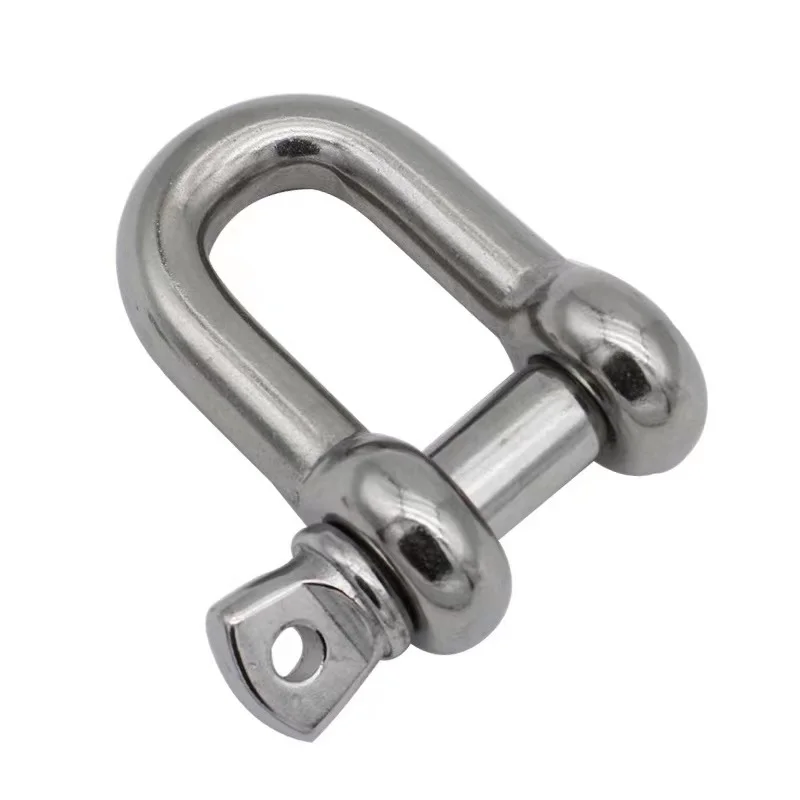
Screw pin shackles are the everyday choice when you need to connect and disconnect gear quickly. The pin threads directly into the shackle body, so most of the time you can spin it in or out by hand. That little bit of convenience adds up fast if you’re breaking down a rig at the end of a muddy job or swapping straps on a trailer. Just keep an eye on the pin—if it gets knocked around, it can loosen on its own.
A bolt-type D shackle feels more deliberate. You’re dealing with a separate bolt, a nut, and usually a cotter pin or locking tab. It’s not as fast to install, but once it’s together, it stays put. That extra security matters when the shackle is buried in a spot you can’t easily inspect or when the load vibrates, twists, or cycles constantly. The bolt’s cross-sectional strength also tends to be a bit higher for the same body size, which is worth remembering if you’re working near the working load limit.
Neither design is universally better—it comes down to how often you’ll touch it and what kind of movement it’ll see. If you’re rigging something temporary or need fast adjustments, a screw pin is hard to beat. If the shackle will stay in place for weeks, sit underwater, or take shock loads, the bolt type gives you one less thing to worry about. A lot of crews keep both on hand and grab whichever fits the task instead of forcing one style onto every lift.
Reading Load Ratings Without Getting Tripped Up by Marketing Numbers
Load ratings look straightforward until you realize the number on the box rarely matches the number that matters. A winch rated for 10,000 pounds might only pull that on the first wrap of bare cable with a fully charged battery and no angle on the line. Once the cable stacks, the voltage sags, or the pull angle shifts, the real-world capacity can drop by a third. The marketing team isn't lying; they're just quoting the best-case scenario and leaving you to discover the fine print.
A better habit is to ignore the headline figure and ask what standard was used, what safety factor is baked in, and what happens under sustained or shock loads. If the rating comes from a test that doesn't resemble how you actually use the gear—static load on a bench instead of dynamic load on a trail—it's not telling you much. Subtract something for age, wear, and conditions, and you'll end up with a number you can trust, not one that only works in a brochure.
How We Gauged Corrosion Resistance Beyond a Quick Salt Spray Test
Salt spray testing has its place, but it rarely mirrors the messy reality of outdoor exposure. We paired it with cyclic corrosion chambers that alternate between salt fog, high humidity, and drying phases, forcing coatings to fail in ways a constant mist never would, especially at scribe marks and edges.
Beyond the chamber, electrochemical impedance spectroscopy on coated panels after each cycle gave us a numeric read on how well the barrier held up before visible rust appeared. Adhesion pull-off tests added another layer, since a coating that stays intact but loses its grip is not much use.
Finally, we set up real-world racks near a coastal industrial site for twelve months and compared those results against the accelerated data, making sure our lab predictions matched what actually happened in the field.
From Anchor Lines to Recovery Straps: Where a Solid D Shackle Earns Its Keep
When you're dropping anchor in a rocky cove, the last thing you want is a weak link between your chain and line. A solid D shackle handles this job without complaint. Its U-shaped body slips through the anchor shank and the thimble of your rope, pin secured, and then it's just you, the tide, and the wind. The load isn't always steady; waves tug and yank, but the shackle's shape spreads that stress across its curve instead of concentrating it at a single point. No fancy features, just a chunk of galvanized steel that's been doing this for decades.
Shift to a muddy trail where a 4x4 has buried itself to the axles. The recovery strap stretches, the tow hooks line up, and someone pulls out a D shackle. It threads through the strap eye and onto the recovery point, taking up the slack. When the tension hits, there's a snap—not from the shackle, but from the strap doing its job. The D shackle doesn't flinch. Its screw pin stays put, even under a side load that would twist a lesser fitting. That's why off-roaders keep a couple in the recovery bag, trusting them more than a quick-link or a soft shackle in some situations.
From saltwater to sand, the D shackle earns its keep by being simple and strong. It's not the most innovative piece of gear, but it doesn't need to be. Whether it's holding an anchor line steady through a squall or connecting a recovery strap for a hard pull, it does one thing: connects two points without letting go. That reliability is why you'll find it on boats, in toolboxes, and in recovery kits, often with a bit of surface rust that just proves it's been used.
Simple Habits That Keep Stainless Shackles From Seizing Over Time
Stainless shackles rarely seize because of one big mistake. It’s the slow buildup of dried salt, dust, and tiny metal particles inside the threads that does it. Make it a habit to back the pin out a few turns after every few uses, wipe the threads with a clean rag, and inspect for any gritty residue before you store the shackle. If you work near saltwater, rinse the pin and the threaded eye with fresh water first, then dry them before reassembling.
A thin film of marine-grade anti-seize on the threads saves more time than it costs. You don’t need much—just enough to coat the surface without it squeezing out onto the load-bearing parts. Reapply it whenever you notice the pin starting to feel dry or if the shackle has been sitting for more than a few weeks. This keeps moisture from wicking into the thread gap and prevents that chalky white corrosion that welds stainless parts together.
How you store the shackle matters just as much as how you use it. Hang it or keep it in a dry bin rather than letting it sit in a damp toolbox or on a wet deck. If you can, leave the pin loose by a quarter turn instead of fully tightened when the shackle is not under load. That tiny air gap stops the threads from bonding under pressure and makes the next removal quick even after months of idle time.
FAQ
In saltwater or coastal conditions, you’ll want 316 stainless steel rather than 304. The molybdenum in 316 gives it much better resistance to pitting and crevice corrosion, which can sneak up on you around threads and load-bearing areas. Also check for a polished or passivated finish—tiny surface imperfections are where rust often gets a foothold.
Strength isn’t just about the shackle’s diameter; you need to match the working load limit to your actual rigging forces. Look for a shackle that has its WLL clearly marked on the body and a safety factor of at least 5:1 or 6:1. If you’re lifting overhead or in dynamic conditions, don’t just glance at the breaking strength—use the WLL as your starting point.
Pin design matters more than people think. A screw pin with a good, deep slot is easy to tighten by hand or with a bar, but it can back out under vibration. For anything that moves or shakes, a bolt-type pin with a nut and cotter pin offers more security. Some shackles also have a captive pin or a hex head that won’t roll away when you need it.
Not at all. The grade of stainless steel makes a big difference. 304 is common and fine for light outdoor use, but 316 offers superior resistance to chlorides, which means it holds up better near the ocean or around de-icing salts. There are also duplex and super duplex grades that combine high strength with excellent corrosion resistance, though they cost more and are harder to find.
Yes, but only if the shackle is rated and marked for lifting. Look for the manufacturer’s name, the working load limit, and a traceability code on the body. Avoid using unmarked or decorative shackles for overhead work. For lifting, the pin should be fully engaged and the load should sit in the bow, not on the pin.
A little maintenance goes a long way. Rinse shackles with fresh water after exposure to salt or chemicals, dry them thoroughly, and apply a light lubricant to the threads. If you notice any galling—where stainless threads start to seize—use an anti-seize compound made for stainless steel. Also inspect the pin and body regularly for cracks or deformation, especially around the ears.
If you want a good balance, look for shackles that are forged rather than cast, made from 316 stainless, and come with a load rating that fits your most common tasks. Some brands offer a mid-range option with a 5:1 safety factor and a smooth pin action. It’s worth paying a bit more for a shackle that has a clean finish and a traceable load rating—cheap no-name shackles often skip the testing that keeps you safe.
Conclusion
Finding a stainless steel D shackle that truly balances brute strength with long-term corrosion resistance often means looking past the mirror finish and the inflated load figures. A 316 stainless body stands out for saltwater use because the added molybdenum fights pitting far better than common 304, especially when the shackle lives on a boat deck or a trailer dunked in the ocean. That said, the pin design matters just as much: a screw pin is quick to swap on a recovery strap, while a bolt-type shackle stays put under vibration and side loads. When reading stamps, ignore the big 'breaking strength' banner and instead check the working load limit, then derate it yourself for shock loads or awkward angles.
Our picks were not judged by a single salt spray chamber run; we cycled them through wet-dry brine, left them fouled with mud, and watched how threads behaved after repeated tightening. A shackle that survives a bench test but seizes after a month on an anchor line is not worth carrying. Real use spans anchor rode connections, snatch block mounts, and soft shackle backups, and in every case the best designs shed water instead of trapping it. A quick rinse with fresh water, a drop of marine grease on the threads, and backing the pin off a quarter turn after loading keep even a budget stainless shackle from turning into a permanently fused paperweight.
Contact Us
Contact Person: Shane
Email: [email protected]
Tel/WhatsApp: 8613357785029
Website: https://www.wanluohardware.com