

Charging Hose Supplier Selection Guide for HVAC Technicians
2026-11-22
Every HVAC technician knows the frustration of a charging hose that fails at the worst possible moment. The right supplier does more than just ship parts—they keep your jobs on schedule and your reputation intact. Whether you're refilling residential units or servicing commercial rack systems, hose quality, connection fit, and burst pressure ratings directly affect your daily results. Among the suppliers worth a closer look, HONGSEN has built a name around dependable construction and practical compatibility. This guide breaks down what actually matters when choosing a charging hose supplier, so you can stop guessing and start working with confidence.
Why Most Charging Hose Failures Start Before the First Use
Most charging hose failures aren't caused by wear and tear on the job site. They happen in the warehouse, the truck, or the storage room—long before the hose ever gets connected to a manifold. The rubber compounds and inner linings used in these hoses are sensitive to heat cycling, UV exposure, and especially to being coiled too tightly for weeks at a time. A hose that sits in direct sunlight on a dashboard or gets crushed under a heavy tool bag will develop micro-cracks and flat spots that never show up in a pressure test. By the time the technician threads on the first fitting, the damage is already done.
Another quiet killer is moisture. Charging hoses with nylon or blended inner barriers can absorb trace amounts of humidity from the air during storage. When that trapped moisture later meets refrigerant and compressor oil at high temperature, it forms acids and sludge that eat the liner from the inside out. Shops that store hoses with open ends, or hang them near wash bays where steam and detergent mist circulate, see a much higher rate of “unexplained” blowouts in the first two weeks of use. The failure wasn't a manufacturing defect. It was storage neglect.
Even the initial uncoiling matters. Many technicians yank a new hose straight from its tight factory coil, which can tear the inner liner at the bend points without leaving a visible mark on the outer jacket. Those invisible tears become weak points the moment the hose sees operating pressure. A simple habit—unrolling the hose gently, letting it relax for an hour, and capping both ends during storage—would stop most early failures before they ever have a chance to cause a refrigerant leak or a nasty burn.
Reading Between the Lines of Pressure Ratings and Refrigerant Compatibility
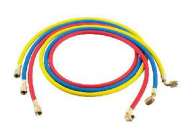
Pressure ratings on a data sheet rarely tell the whole story once a system moves beyond a single refrigerant. A component stamped for 700 psig may hold up fine with R-410A but fail early with R-32 or a blended drop-in, not because the peak pressure differs wildly, but because the refrigerant attacks seals, gaskets, or lubricants in ways the rating alone never captures.
Compatibility gets trickier with blends that exhibit temperature glide. The pressure-temperature relationship shifts across the evaporator and condenser, so the same nominal rating can mask uneven loading at joints and valves. Field technicians often misread a stable gauge reading as proof of margin, while the real risk sits in elastomer swelling, copper plating, or oil return problems that don't show up until a compressor tears itself apart.
A better habit is to treat the pressure rating as a boundary condition, not a compatibility guarantee. Check the refrigerant's chemical family, the oil it prefers, and the materials inside every wetted component. Where old systems ran for years on mineral oil and R-22, newer HFO blends can expose brittle gaskets or slow leaks that a hydrostatic test never sees. That distinction is what separates a reliable retrofit from an expensive field failure.
The Fitting Finish That Separates Field-Ready Hoses from Bench Warmers
A hose that gets dragged across concrete, sprayed with process water, and connected and disconnected twice a shift tells you a lot through its fittings. Sharp thread edges, uneven plating, or a rough ferrule bore are not cosmetic flaws; they chew up gloves, nick O-rings, and turn routine maintenance into a slow bleed of small failures. A clean chamfer, consistent coating, and burr-free shoulder feel deliberate because they are. That kind of finish usually means the assembly was built to be handled, not just photographed.
Finish also changes how a fitting mates under torque. Plating that goes on too heavy closes down thread tolerances; plating that goes on too thin leaves base metal open to corrosion before the hose ever leaves the truck. When the surface is controlled properly, the fitting threads spin in without galling and seat at the expected depth, so the connection reaches its real clamping load instead of merely feeling tight. Field crews notice that difference quickly because it removes the guesswork from every hookup.
Plenty of assemblies look respectable on a rack and never survive the first winter washdown. The difference is usually in details that are easy to miss until they leak: porosity in a thread root, micro-cracks around the ferrule, or a stem end that is slightly out of flat. When those details are right, the hose becomes a tool that gets used daily rather than a backup that stays coiled on the bench. That is the gap between looking assembled and being ready for the field.
What a Supplier’s Lead Times Reveal About Their Real Inventory
A supplier's lead time often gets read as a shipping estimate, but it is usually a quiet signal about how much stock they actually hold and how confident they are in their own replenishment. Short lead times rarely mean faster trucks. More often, they point to finished goods already sitting in a warehouse, or a production line with spare capacity. When the quoted window starts creeping from five days to fifteen, that shift usually has less to do with freight and more to do with the supplier no longer carrying buffer inventory.
Longer lead times can also reveal which inputs are bottlenecking. A supplier that suddenly quotes four extra weeks for a standard part may be waiting on raw materials they did not reserve, or they may be grouping orders to justify a production run. In either case, the delay says their real inventory position is tighter than their catalog suggests. This is why buyers should track lead time changes over time rather than treating a single quote as fixed. A gradual increase across several orders usually means depleted safety stock and a supplier that is now making to order instead of shipping from a shelf.
The most useful questions come from the pattern. A supplier whose lead times stay stable despite market swings is probably holding real inventory or has priority access to components. One whose windows bounce around by product line is likely allocating scarce stock to favored customers. Asking for an explanation of the range, not just the fastest date, tends to uncover whether the inventory is physical, promised, or contingent.
Questions to Ask About Warranty When You Work with Mixed Refrigerants
Warranty talk usually gets skipped until a compressor fails, and with mixed refrigerants that delay can get expensive. Ask whether the manufacturer treats any refrigerant blend outside the original spec as contamination, and whether that voids coverage for the entire system or only for parts directly damaged. Some distributors will still honor a parts warranty if you can show a clean refrigerant analysis from a certified lab, but they rarely advertise that option.
Push for specifics on recovered refrigerant. If you recharge with reclaimed product that meets AHRI 700, does the warranty still apply, or do they require virgin refrigerant from a sealed container? Ask if batch documentation, recovery logs, or a recent gas chromatograph report is enough proof, and get the answer in writing. A verbal yes from a counter guy will not help much when the claim is reviewed by a different department.
Also clarify what happens with labor and refrigerant disposal if a mixed charge causes a failure. Many policies cover the replacement part but leave you holding the bill for evacuation, flushing, filter driers, and recharging. If the system has a history of mixed refrigerant, ask whether the manufacturer will cover that cleanup work or only the failed component. The answer often changes how you quote the job and what you write on the invoice.
How to Compare Total Cost Without Falling for the Cheapest Reel
Price tags rarely tell the whole story. A reel that looks cheap upfront often hides extra costs in replacement parts, shorter service life, or poor performance under load. Instead of grabbing the lowest number on the shelf, start by mapping out what you actually need the reel to do—how often it will be used, what line weights it will handle, and whether it will face salt, sand, or heavy fish. That picture makes it easier to see when a slightly higher price buys a sealed drag, better bearings, or a frame that won't flex after a season.
Break the cost down over time. A $40 reel that needs new bearings and a drag rebuild after one season can end up costing more than a $90 reel that runs five years without a parts order. Check what owners say about long-term wear, not just out-of-box smoothness. Look for reels that share spare parts with other models in the same lineup—that often signals a manufacturer confident enough to support the product instead of treating it as disposable.
Compare the whole package, not just the initial receipt. Factor in line capacity, gear material, handle knobs, and whether the reel feels balanced on your rod. Sometimes the mid-priced option delivers 90% of the premium performance without the brand markup. The goal isn't to avoid spending money; it's to avoid paying twice for something that should have worked the first time.
FAQ
Look at the hose construction instead of relying on catalog photos. A nylon inner core and a clean, even crimp tell you more than a polished product image. Ask for working pressure and burst pressure side by side; if a supplier will not share those numbers, keep moving.
A hose rated for at least 800 psi working pressure and around 4,000 psi burst pressure covers most R-410A and R-32 jobs without trouble. Higher ratings do not hurt, but avoid sacrificing flexibility for a pressure level you will never reach.
Not always. Some older rubber compounds break down when exposed to POE oil and higher-pressure refrigerants. Confirm the hose is marked for R-410A, R-32, and the lubricants you use, and check that the gaskets are compatible as well.
Call them before you buy. A supplier that can clearly describe the inner core material, crimp tolerance, and replacement gasket part numbers is usually one that will support the hose later. Vague answers often mean vague warranty support.
Yes. A 60-inch hose with compact ball valve ends can reach service ports without kinking, while longer hoses make manifold work easier but increase refrigerant loss during disconnect. Match the length and ends to your normal unit setup rather than the lowest price.
Uneven crimps, exposed braid near the fittings, stiff spots right out of the package, and gaskets that fall out when the cap is removed are all bad signs. A good hose should feel flexible, coil without resistance, and seal on the first connection.
If you regularly use the same lengths and end fittings, a kit can save money. But when you need a longer high-side hose and shorter low-side hoses, buying separately prevents paying for hoses that will just sit unused in the truck.
Ask about production testing. Reputable suppliers pressure-test every hose or batch before shipment and should be able to explain the procedure. If they only mention quality control in broad terms, request a written specification sheet before committing.
Conclusion
Most charging hose failures are baked in long before a technician ever threads a fitting onto a service port. A hose that looks fine on the shelf may already have liner damage from poor mandrel control, inconsistent barrier layers, or crimping that leaves the assembly prone to seepage under vacuum. Pressure ratings tell only part of the story; a hose stamped for 800 psi working pressure can still stiffen or turn gummy if the inner tube is not matched to the actual refrigerant blend, especially with A2Ls and older R-22 drop-ins sharing the same truck. The fitting finish is another early filter. Brass that shows rough threads, thin plating, or uneven knurling tends to bind, gall, or lose its seal after a few dozen hookups. Field-ready hoses usually have smooth, well-formed flare seats and strain relief that does not look like an afterthought.
Supplier behavior often predicts what ends up in your tool bag. If lead times stretch or change by the day, that usually means the supplier is drop shipping or running hand-to-mouth inventory, which leaves technicians waiting when a manifold set fails mid-season. Ask directly whether the hose is assembled in house, whether the crimp dies are actually sized for the fittings being used, and how the supplier handles warranty claims when one truck carries R-410A, R-32, and an older mineral-oil system. A vague promise of one year means little; a credible supplier will explain what the warranty covers after mixed exposure and whether they replace the hose or just the fittings. Price comparisons should include downtime, rework, and the cost of losing charge during a callback, not just the reel price. The cheapest hose frequently becomes the most expensive once a technician is back on the same roof twice.
Contact Us
Contact Person: KOPASS HO
Email: [email protected]
Tel/WhatsApp: 8613606566112
Website: https://www.hongsenref.com/