

Glue Dispensing Machine Supplier Essentials for Precision-Driven Production
2026-11-16
In precision-driven manufacturing, the choice of a glue dispensing machine supplier can make or break your production line. From microelectronics to automotive assembly, every drop of adhesive must land with exacting accuracy—and the partner behind the equipment matters just as much as the machine itself. That's where JATEN comes into focus. But what should you really look for in a supplier beyond the spec sheet? This guide cuts through the noise to reveal the essentials that separate dependable partners from costly compromises. Keep reading to discover how to future-proof your dispensing process with confidence.
Pinpoint Accuracy Starts with Supplier Process Control
Precision is rarely created at the final inspection stage. It is either built into the supplier's process or it is not. When a machined component arrives with a tolerance of ±0.005 mm, that number means nothing unless the supplier can demonstrate how their equipment, tooling, and operator methods maintain that band hour after hour. Pinpoint accuracy, in other words, is a property of upstream process control, not downstream measurement.
Effective supplier process control starts with defined parameter windows for every critical operation. A supplier that cannot tell you the cutting speed, feed rate, coolant temperature, and tool change interval for a given part is guessing. The best suppliers use statistical process control charts, not as wall decoration, but to catch drift before it becomes a nonconformance. They also run gage repeatability and reproducibility studies to ensure their measurement system is not adding noise to the data. If the measurement error consumes more than 10% of the tolerance band, even a perfectly stable process will produce false acceptances.
The final piece is transparent data exchange. Rather than waiting for a monthly quality report, top-tier buyers insist on real-time alerts when a key process parameter trends toward a control limit. They review supplier process capability indices such as Cpk and Ppk, not just defect counts, because a supplier with a Cpk of 1.0 is already on the edge of failure. When both sides treat the supplier's process as an extension of the buyer's own production line, pinpoint accuracy stops being a hope and becomes a predictable outcome.
Reading the Fine Print on Dispensing Repeatability Claims
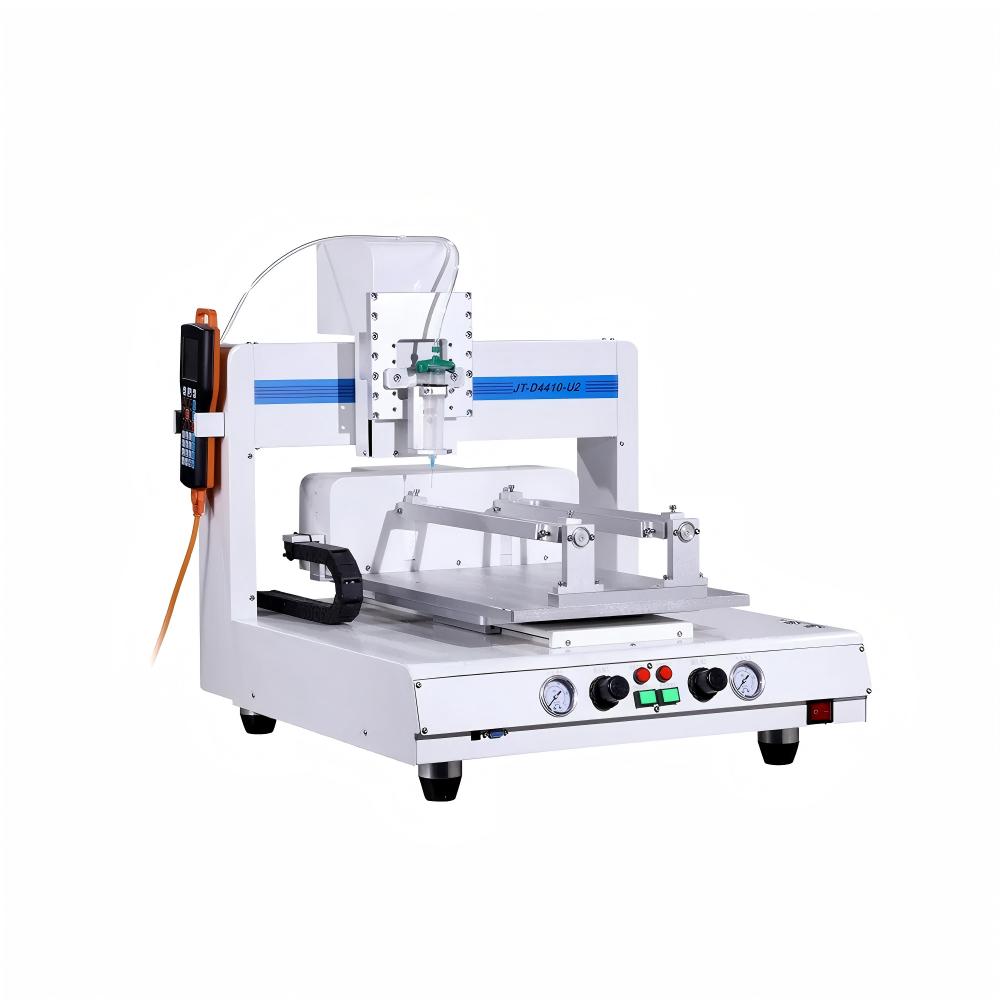
Manufacturers love to quote a single repeatability figure, but the fine print often reveals that the number was achieved under conditions that bear little resemblance to a real production line. For instance, the test may have used a low-viscosity fluid, a brand-new needle, and a climate-controlled room, while your process involves a filled abrasive paste, a slightly worn tip, and ambient temperature swings. Those qualifiers matter more than the headline percentage.
Another common trick is to report repeatability based on a short burst of cycles immediately after calibration, excluding long-term drift or operator-to-operator variability. You might see a claim like plus or minus one percent over ten dispenses, but if the data ignores the gradual shift in flow rate after an hour of continuous use, or the inconsistency introduced when a different technician reloads the syringe, the number is essentially meaningless for high-volume work.
The smart approach is to ask for the raw test protocol, not just the summary statistic. Find out the sample size, the viscosity range tested, whether the needle was changed during the trial, and how outliers were handled. Better yet, run your own short capability study using your actual material and environment. That will tell you more than any glossy spec sheet.
Why Material Viscosity Changes Everything in Supplier Selection
Viscosity isn't just a number on a datasheet—it's the silent force that decides whether a supplier can actually deliver what your process demands. A resin that flows too thick at room temperature might clog dispensing lines in your factory, while one that runs too thin could compromise the structural integrity of the final part. The best suppliers don't just quote a single viscosity value; they understand how that viscosity shifts with temperature, shear rate, and even storage time. When you're comparing vendors, ask them to walk through real-world viscosity curves for their material under your exact operating conditions. If they hesitate, that's your first red flag.
Most sourcing teams overlook the compounding effect of viscosity on logistics and handling. A material with low viscosity might be easier to pump but harder to keep mixed, forcing you to invest in constant agitation or specialized shipping containers. On the flip side, a highly viscous product may require heated lines and longer dwell times, which quietly eats into your throughput. Suppliers who have dealt with these trade-offs across multiple industries will proactively suggest stabilizers, alternative packaging, or even a custom formulation tweak. They won't just sell you a bucket of goo—they'll help you map viscosity behavior across your entire supply chain, from receiving dock to final cure.
At the end of the day, viscosity is the variable that separates commodity suppliers from true partners. A vendor who treats it as an afterthought will blame your equipment when things go wrong. A vendor who treats it as a design constraint will already have tested their material in a setup like yours, documented the failure modes, and prepared a fallback grade. When you're making a shortlist, don't just compare price per kilogram. Compare the depth of viscosity-related troubleshooting each supplier can bring to the table—that's where long-term savings hide.
The Hidden Costs of Overlooking Custom Fixture Design
When a production team settles for off-the-shelf fixtures, the immediate savings on the invoice rarely reflect the true financial picture. Standard mounting brackets, clamps, or alignment jigs often force operators into awkward workarounds — adding shims, re-drilling holes, or manually adjusting positions between cycles. Each improvised step consumes minutes that compound across thousands of units, quietly eroding throughput while nobody tracks the cumulative labor cost. Before long, the “cheap” fixture has paid for itself several times over in lost productive hours, yet the expense never appears on any single budget line.
Beyond direct labor, generic fixtures introduce a subtler drain through accelerated wear on both tooling and product surfaces. A clamp that grips slightly too hard leaves witness marks that require secondary finishing; a locating pin that sits half a millimeter off forces cutting tools into uneven contact, dulling edges prematurely. These secondary effects ripple outward — rework stations grow busier, scrap bins fill faster, and maintenance schedules creep closer together. The hidden cost isn’t just the fixture itself, but the entire constellation of adjustments, repairs, and quality concessions that spring up around it.
Perhaps most insidious is the design debt that accumulates when custom fixture engineering is deferred. Process engineers begin to accept marginal setups as “the way we’ve always done it,” embedding inefficiency into standard operating procedures. New hires learn workaround habits as if they were best practices. When the time finally comes to optimize the line, unlearning these ingrained patterns costs more than any bespoke fixture would have from the start. Overlooking custom design doesn’t merely waste today’s resources — it quietly raises the baseline for what a team considers acceptable performance.
Service After the Sale: Calibration, Spare Parts, and Response Time
Calibration isn't a one-time checkbox here. Every instrument that leaves our facility gets logged into a service calendar, and when the due date approaches, we reach out before you even think about drift. Our techs use traceable standards and document each adjustment, so you get a clear record without having to chase it down. If a unit falls outside spec between scheduled visits, the recalibration is on us—no invoice games.
Spare parts sit on our own shelves, not in some distant warehouse that takes weeks to ship. We stock the components that actually wear out: seals, sensors, filters, and the odd board that fails under heavy use. For customers who rely on us for critical lines, we hold dedicated safety stock so a replacement can go out the same day. It's not about having every part imaginable; it's about having the right ones before you need them.
Response time means little if it's measured from when a ticket gets opened rather than when you first notice a problem. We keep our service line staffed by people who know the equipment, not a call center script. For high-priority breakdowns, we aim for a four-hour callback and next-day on-site support within our coverage zones. Remote diagnostics often cut that shorter—many issues get sorted before a technician even packs a bag.
From Prototype Runs to Full Lines: Keeping Dispense Tolerances Tight
Moving from prototype runs to full production lines often exposes dispensing tolerances that seemed acceptable at low volumes. A bead width that shifted by 0.1 mm during a handful of test parts can become a 0.5 mm drift across thousands of cycles, driven by changes in material temperature, needle wear, or slight variations in valve response. The first step in keeping tolerances tight is to lock down the process parameters early: record the exact dispense pressure, time, and nozzle height that worked on the prototype, then verify them against continuous run data rather than relying on operator judgment.
Full-line repeatability also demands more than just frozen settings. In a prototype, a skilled technician might compensate for a thinning adhesive by eye, but automated lines need closed-loop feedback or at least scheduled calibration checks. Monitoring dispense volume by weight every hour catches drift before it becomes a reject, while using temperature-controlled reservoirs keeps viscosity stable enough to hold the same bead shape through shift changes. Simple changes like swapping to a harder needle tip or lowering the dispense acceleration can reduce variation more than chasing perfect parameter values.
Finally, it helps to treat tolerance as a shared target between engineering and production. Sharing the prototype’s acceptable range clearly with line operators, and giving them a simple go/no-go gauge for bead cross-section, makes deviations visible without waiting for a lab test. Over time, tracking batch-to-batch adhesive lot differences and adjusting one variable at a time builds a history that lets you predict when a line will drift, instead of discovering it in final inspection.
FAQ
A supplier with real process knowledge will ask about your substrate materials, adhesive rheology, and tolerance window before quoting a machine. They should be able to provide dispense consistency data from similar applications and discuss how their control software handles temperature drift or viscosity shifts during a run. Look for engineers who treat dispensing as a closed-loop system rather than just a pump and a needle.
Request a live bench test using your actual adhesive and target part geometry. Have them run the same deposit pattern at least 50 cycles and measure weight or volume variation. A serious supplier will also share the calibration procedure for their flow sensors and the tolerance stack-up between needle, valve, and motion axes. If they hesitate to test with your material, that is a red flag.
Piezoelectric jet valves and needle-type positive displacement valves dominate this range. Piezo jets excel at non-contact, high-frequency micro-dots, while positive displacement handles a wider viscosity range with fewer satellites. The real differentiator is how the supplier tunes the valve driver waveform to your adhesive's shear-thinning behavior—off-the-shelf settings rarely hit sub-0.1 mm targets without custom characterization.
High-mix lines change substrates, adhesives, and patterns frequently. If the dispensing controller has limited I/O mapping, no native Ethernet/IP or PROFINET support, or requires manual position teaching for every SKU, changeover time explodes. A strong supplier will provide recipe management that ties dispensing parameters to the part barcode and synchronizes motion commands with the robot or gantry controller, so the line stops only when material runs out.
Filled adhesives with ceramic or metal particles wear out seals, needles, and valve seats quickly. A capable supplier will offer accelerated wear testing with your exact filler loading and report expected component life in cycles. They should also recommend wetted path materials—like tungsten carbide or ceramic inserts—that resist erosion without swelling in your solvent or activator. Skipping this step leads to unplanned downtime and drifting deposit sizes mid-batch.
Look for suppliers that implement closed-loop pressure control and suck-back tuning at the needle tip. A well-tuned system stops dripping during head travel and avoids over-dispensing on edge beads. Some suppliers also offer software that calculates the minimum required shot volume per part and automatically adjusts valve open time based on real-time viscosity sensing. That reduces purge waste and material cost without touching the motion profile.
Beyond a warranty, expect application engineering support that includes remote diagnostics with logged process data, spare part stock recommendations tied to your throughput, and calibration service that aligns with your ISO or IATF audit schedule. The best suppliers will proactively monitor machine health and suggest preventive maintenance before accuracy degrades, not just respond when the line is down.
Custom becomes cheaper when the off-the-shelf machine forces you to compromise on fixture repeatability, needle positioning, or integration with a cleanroom enclosure. If you are spending more than 15% of the machine cost on retrofits—custom brackets, special valves, software workarounds—then a purpose-built head or gantry from a supplier who already understands your part family will pay for itself within the first year of reduced scrap and changeover time.
Conclusion
Precision in glue dispensing starts long before the first bead is laid. A supplier's process control—how they monitor temperature, pressure, and flow in real time—dictates whether your 0.2 mm tolerance holds across a shift. Repeatability claims on a datasheet mean little without asking what happens at hour six, after material shear and nozzle wear. Viscosity shifts, often overlooked, turn a perfect morning run into afternoon rework. The right supplier doesn't just sell a machine; they map your adhesive's behavior under your specific production rhythm.
Custom fixture design rarely appears on a quote, but its absence shows up as scrapped boards and fiddly changeovers. Post-sale support—calibration intervals, spare part lead times, and how fast a technician actually picks up the phone—separates a partner from a one-time vendor. Moving from prototype to full line tests everything: dispense tolerances must survive thermal drift, operator variation, and rush orders. Choose a supplier who treats those variables as their problem, not yours, and precision becomes a baseline rather than a daily battle.
Contact Us
Contact Person: Volien
Email: [email protected]
Tel/WhatsApp: +86 18029161762
Website: https://www.jatentech.com/