

Reliable Batch Off Cooler Exporter for Superior Rubber Processing
2026-10-26
Every rubber processing line eventually hits the same bottleneck: if the batch off cooler can’t keep up, finished sheets pile up, stick, or cool unevenly. That’s where choosing the right exporter makes all the difference. SFC has built its reputation on reliable batch off coolers that handle high-output rubber processing without the usual headaches—no uneven cooling, no material waste, no unplanned downtime. In this post, we’ll walk through what to look for in a batch off cooler supplier and why SFC’s approach stands out.
Cooling Precision That Keeps Rubber Batches Uniform
The challenge with rubber batches isn't just reaching a target temperature; it's doing it evenly across the entire mass. A cooling system that only chills the outer layer leaves the core warm, which leads to inconsistent viscosity and curing behavior later. Precision cooling here means controlling drop temperature within a narrow band, often plus or minus a couple of degrees, while managing water flow, spray pattern, and tray speed. It's less about blasting cold air and more about steady, repeatable heat removal that matches the batch's own thermal profile.
In practice, this often involves multi-zone cooling decks or mill baths where each section has its own temperature sensor and flow valve. Rather than relying on a single setpoint, the system adjusts in real time as the rubber moves through. When the surface temperature creeps up, the controller trims the water or air supply just enough to pull it back without overcooling the edges. That kind of granular control is what keeps the final compound from drifting between batches, especially with high-viscosity or heat-sensitive formulations.
Your Export-Ready Batch Off Cooler Partner
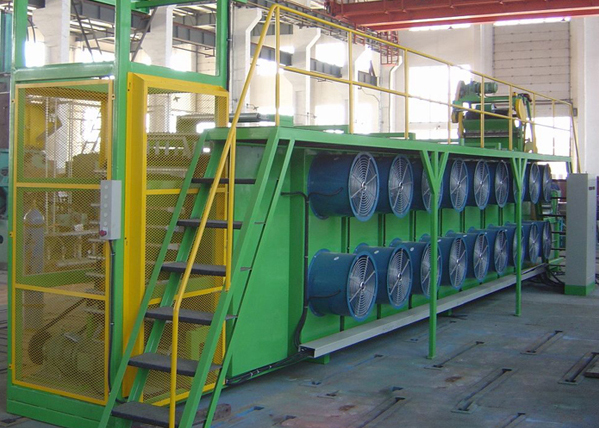
When your production line can't afford downtime waiting for rubber slabs to cool, a batch off cooler that arrives wired, tested, and crated for shipment changes the equation. Our units leave the floor with full documentation, corrosion-resistant packaging, and voltage settings matched to your destination grid—no last-minute retrofits at the port.
What sets this partnership apart is the pre-export checklist: every chain, blower, and dip tank is load-tested before the container seals. You receive time-stamped inspection photos and a packing list that mirrors the installation sequence, so your local crew isn't guessing on day one.
From tropical humidity to cold-climate transit, we size crating, desiccants, and rust inhibitors to the route—not just the machine. That means the cooler arrives ready to bolt down, calibrate, and run, without hidden freight claims or missing brackets.
Robust Design for Non-Stop Rubber Processing
In rubber compounding and extrusion, stopping a line isn’t a simple pause—it’s a race against premature crosslinking and material degradation. Robust design for non-stop processing starts from the assumption that every component will be pushed past its comfort zone. Barrel liners are specified not just for hardness but for thermal fatigue resistance under cyclic heating, while feed sections are shaped to handle inconsistent crumb size without bridging or surging.
Screw geometry gets particular attention: deeper channels in the feed zone reduce shear heating, and barrier flights near the metering zone prevent unmelted or poorly mixed stock from reaching the die. Temperature control loops are split into short zones with independent actuators, allowing fast correction before a hot spot can force a shutdown. Wear surfaces use bi-metallic or ceramic coatings, and seal designs are purged continuously to keep abrasive fillers from chewing through shaft interfaces.
The result isn’t just longer uptime—it’s a process that tolerates raw material variation and operator timing without drifting out of spec. Accelerated life testing on prototype screws and barrels, combined with thermal imaging under full load, identifies failure modes before they appear on the production floor. When a line is designed to keep running through those moments that would normally trigger an emergency stop, maintenance becomes predictable rather than reactive.
Delivering Batch Off Coolers Across Continents
Shipping a batch off cooler from our workshop to a plant on another continent means more than booking freight. Every unit gets torn down into modules that fit flat racks and open-top containers, with lifting lugs and spreader bars marked for reassembly. We learned long ago that a 30-tonne machine can move safely if the drive side, fan deck, and cooling rack are separated before they ever reach the port.
Port handling varies wildly, so crating is built for the worst leg of the trip. Motors are bolted to steel cradles, chain drives get vacuum-sealed with desiccant, and all exposed shafts receive heavy wax coating. The goal is simple: when a crew in another time zone opens the shipment, every component should be ready for leveling and alignment, not scraping rust or hunting for missing fasteners.
Installation support goes with the equipment. Our engineers stay on call across time zones, walking local teams through final placement, belt tension, and first-run cooling curves. That continuity is what keeps a cross-continental delivery from turning into a cross-continental headache.
Advanced Cooling for Superior Compound Integrity
Rapid temperature swings during compounding often create micro-fractures that stay hidden until final part testing. The cooling stage isn’t just about lowering heat—it’s about controlling the rate of thermal contraction so the polymer matrix and any embedded reinforcements don’t pull apart at different speeds. A staged cooling profile, where the first zone drops temperature quickly to freeze surface geometry and the second zone releases heat more gradually, keeps the compound’s structural memory intact without introducing residual stress.
Traditional water-bath cooling tends to quench the outer skin while the core remains molten, creating a shell that traps shrinkage and leads to warpage or void formation. By switching to a multi-zone air or mist cooling system with adjustable airflow, operators can tune the heat transfer coefficient to match the specific compound’s crystallization window. This prevents premature surface solidification and lets the entire cross-section reach a uniform temperature before final sizing.
For highly filled or fiber-reinforced compounds, even a 5°C difference across the extrudate can be enough to bend long fibers or create internal shear planes. Advanced cooling uses temperature sensors placed at the die exit and mid-cooling points to feed real-time adjustments back to the chilling unit. The result is a compound that retains its original dispersion quality, dimensional accuracy, and mechanical performance—without relying on post-process annealing to fix what improper cooling broke.
The Reliable Core of Your Rubber Cooling Stage
The heart of any rubber cooling line is the stage where temperature drops evenly and cleanly. Here, that means a drum or conveyor core engineered to hold dimensional stability under repeated thermal cycling. The surface finish resists sticking, so uncured or semi-cured sheet doesn't drag, fold, or tear as it passes through. Operators notice fewer snags and less manual intervention, even on long runs.
Cooling performance hinges on water flow through the core. Our internal channels are spaced and sized to avoid hot spots, pulling heat out at a steady rate across the full width. That uniformity matters when you're pulling thin gauge stock or high-tack compounds that punish uneven cooling. The result is a sheet that leaves the stage at a predictable temperature, ready for stacking or further processing without re-tack.
Durability isn't just about thick steel. The bearings, seals, and drive coupling are matched to handle wet, warm, slightly acidic plant air without seizing. Maintenance is straightforward, and wear parts are easy to reach. For plants running three shifts, that translates to fewer unplanned stops and a cooling stage that stays in spec year after year.
FAQ
It takes hot rubber sheets or strips coming off a mixing mill or internal mixer, cools them down evenly, and applies an anti-tack coating before stacking them. This prevents scorching and keeps the material from sticking together during storage.
A focused exporter understands regional power requirements, shipping constraints, and after-sales support needs. They also tend to carry spare parts and offer installation guidance that generic suppliers often skip.
Look at the cooling path length, fan capacity, and whether the conveyor speed can be adjusted. Robust frame construction and temperature-resistant belts are also good signs that it won't buckle under continuous operation.
Sticky or high-oil compounds, as well as heat-sensitive formulations, benefit significantly. Uniform cooling and anti-tack application reduce defects like blooming or surface tack that can ruin downstream processing.
Regular cleaning of the dip tank, checking belt tension, lubricating chain drives, and inspecting fan blades for dust buildup. Replacing worn-out anti-tack brushes before they harden also prevents material sticking.
Yes, reputable exporters usually offer modular designs with adjustable discharge heights, variable cooling sections, and options for either batch or continuous stacking. The key is sharing accurate floor space and output targets early.
Voltage and frequency compatibility, spare parts list, installation supervision, and whether the anti-tack system uses dip or spray. Also confirm the estimated delivery time and what documentation will accompany the shipment.
It locks in the compound's physical properties by preventing premature crosslinking. Sheets that cool evenly without residual heat show better consistency in tensile strength, elongation, and surface finish.
Conclusion
When rubber compounding reaches the cooling stage, consistency is not a luxury—it is the difference between a batch that performs and one that fails. Our batch off coolers are built around precision temperature control that keeps every rubber batch uniform, eliminating hot spots and uneven cure behavior. As an export-ready partner, we have spent years refining designs that hold up under continuous operation, with reinforced frames and cooling decks that do not surrender to heat, moisture, or round-the-clock production. From first commissioning to full-capacity runs, the equipment stays stable, which means fewer stoppages and less rejected material.
That dependability is why processors in multiple regions rely on us for batch off coolers that travel well and install without drama. We do not just ship machinery—we deliver a cooling core that protects compound integrity across every batch leaving the line. Whether the rubber is destined for tires, automotive parts, or industrial goods, the cooling stage must not introduce variability. Our coolers use advanced airflow and belt tracking to maintain even exposure, while the modular construction simplifies maintenance and long-term service. The result is a cooling line that feels less like a purchased item and more like a built-in part of your production rhythm.
Contact Us
Contact Person: Chen Zhengwei
Email: [email protected]
Tel/WhatsApp: +86-13963975727
Website: https://www.sfcrubbermachine.com