

Top Cabinet-Type Static Var Generator Factory in China Delivers Reliable Power Quality Solutions
2026-11-16
Voltage dips and reactive power swings rarely announce themselves—until a production line stops or a drive faults. That’s why more facility teams are looking closely at cabinet-type static var generators, and why GEYA has become a trusted factory name in China for power quality. Its SVG systems fit standard cabinet footprints yet respond quickly enough to keep sensitive loads stable. In this post, we break down what makes GEYA’s cabinet-type SVG solutions a dependable choice for demanding electrical networks.
On the Factory Floor Behind Reliable Cabinet-Type Static Var Generators
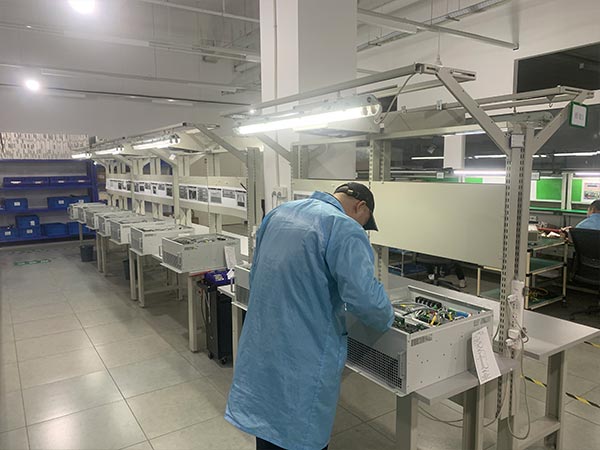
A quiet row of steel enclosures moves down the assembly line, each cabinet taking shape through a sequence of manual checks rather than a single automated pass. Technicians torque busbar connections to a fixed order, route fiber-optic control lines through dedicated channels, and verify that every IGBT module sits flush against its cold plate before the side panels go on.
The real difference shows up in the test bay, where each finished SVG runs through unbalanced-load simulations and short-duration overloads that mimic conditions on crowded low-voltage networks. Readings are logged against the unit’s serial number, so a drift in response time or a slight voltage imbalance in the internal DC bus triggers a rework loop instead of a shipping label.
What leaves the floor is not a collection of components but a cabinet whose cooling path, control board spacing, and filter placement have been checked against the same drawings by three separate sets of eyes. That repetition may be unglamorous, yet it is the part of the process that keeps field failures rare and maintenance visits predictable.
How Modular Cabinet Design Keeps Power Factor Correction Compact
Space inside an electrical enclosure is rarely generous, and power factor correction banks typically eat into it with rows of capacitors, contactors, and reactors bolted to a single back panel. A modular cabinet approach changes that by splitting the system into narrow, self-contained sections that slide in and out on rails or hinged subframes. Each module holds a matched capacitor step, its switching device, and protection, so the physical footprint mirrors the electrical steps rather than forcing everything into one oversized assembly. The result is a cabinet that fits through standard doorways and leaves enough clearance for airflow and cable bending radii without sacrificing correction capacity.
What makes the compact layout work in practice is the way busbars and wiring are distributed vertically through a shared riser instead of sprawling across the panel. Since each module connects to the same vertical bus system, adding or removing a step does not require reworking the entire enclosure. Field engineers can pull a single module forward, replace a failed component, and push it back without disturbing adjacent stages. This plug-in style of construction also cuts down the number of custom busbar bends and long cable runs that would otherwise consume space and make thermal management harder.
Beyond the dimensional savings, the modular frame holds its own under fault conditions and daily thermal cycling. Short horizontal busbar spans reduce hot spots, and the compartmentalized design keeps a single capacitor failure from spreading heat into neighboring steps. In plants where harmonics or load changes force frequent step switching, the compact arrangement still provides enough separation to keep contactor arcs and capacitor venting contained. In short, the cabinet stays smaller not by shrinking components, but by organizing them so every cubic inch does useful work.
What Happens When Static Var Generator Production Starts With Real Grid Conditions
Factory test bays rarely behave like a substation. When production starts with real grid conditions, the first thing that surfaces is how much the control loop depends on clean voltage waveforms. Harmonics, phase imbalance, and sudden load throws push the inverter's sensing and firing timing in ways a perfect bench supply never does. That early exposure changes component choices, particularly around filtering and damping, before designs get locked into volume builds.
Another shift shows up in thermal and acoustic behavior. Real grid impedance varies from site to site, and a static var generator that runs quietly on a stiff test source can develop audible switching noise or uneven module temperatures when connected to a weaker feeder. Building production tests around recorded fault traces and field impedance profiles forces the engineering team to address those variances at the assembly stage instead of after commissioning.
The payoff tends to arrive during startup. Units that have already been exercised against distorted, unbalanced, and dynamically changing grid conditions trip less often, sync faster, and need fewer parameter adjustments in the field. It slows down the first production batches, but it also removes the usual cycle of remote firmware patches and site revisits that erodes customer confidence.
The Engineering Choices That Lower Harmonic Distortion and Speed Up Response
Lowering harmonic distortion starts well before the final gain stage. Input networks are trimmed to keep common-mode swings small, and current mirrors are degenerated just enough to kill high-order artifacts without throwing away headroom. Feedback loops are compensated with a light touch—too much phase margin sounds dead, too little turns transients into ringing that masks the quiet decay of a cymbal.
Speed comes from the same places distortion hides. Drivers run in class A up to surprisingly high output levels, so crossover recovery never has a chance to smear fast attacks. The output stage bias is set by sensing thermal drift directly on the die, not through a distant heatsink, which keeps quiescent current honest after long sessions. Supply decoupling is staged so local rails stay stiff when a bass transient demands current in a few microseconds.
The result is a signature that doesn't advertise itself with warmth or sparkle. It just stops adding what wasn't in the recording. Leading edges snap, harmonics settle in natural proportion, and you notice the space around instruments instead of the amplifier's opinion.
From Load Testing to Long-Term Support in the Cabinet-Type SVG Delivery Cycle
Cabinet-type SVG projects rarely end at commissioning. The load testing phase, often treated as a final checkpoint, actually opens the door to a much longer conversation about how the equipment will behave under real, fluctuating grid conditions. What looks stable in a controlled test can shift once harmonic profiles change or parallel capacitor banks switch in and out. That is why the handover documents matter less than the ongoing dialogue between the plant engineer and the supplier.
Long-term support here is not a vague promise of annual check-ups. It includes tracked thermal cycling data from the power modules, periodic re-tuning of control loops after nearby load additions, and firmware updates that account for newly observed resonance points. A well-supported cabinet-type SVG tends to develop a service history that reads more like a logbook than a warranty card, with each entry tied to a specific operational event rather than a calendar date.
The real shift happens when teams stop treating load testing as a pass-or-fail gate and start using it as a baseline snapshot. From that baseline, support becomes a series of small, evidence-based adjustments instead of reactive fault-finding. In this cycle, the cabinet enclosure itself becomes less important than the data flowing out of it, and the supplier's value shifts from delivering hardware to helping the user interpret what the power quality measurements are quietly saying over months of normal duty.
Where Heavy Industry Turns to a Cabinet-Type Static Var Generator Factory in China
Inside a Chinese cabinet-type static var generator plant, the real work usually starts at the test bay, not the showroom. A 690V unit gets pushed against a simulated arc furnace load while engineers watch how the IGBT stacks absorb harmonic spikes and how quickly the control loop recovers. For a mill electrician, that floor-level validation carries more weight than a polished catalog filled with nominal ratings.
Heavy industry tends to arrive with the same three demands: cabinets that can survive conductive dust, reactors that stay quiet at full compensation, and terminal arrangements that match existing switchgear without field improvisation. Most orders move from drawing review to a full-size mock-up within two weeks, because a steel or mining project cannot afford to discover interface problems during commissioning.
The factory's edge is not just lower cost. It shows up in the willingness to rework busbar routing, fan placement, and control wiring around a specific plant layout, then test the finished cabinet against the customer's own load profile instead of a generic resistor bank.
FAQ
Unlike conventional capacitor banks that switch in fixed steps, a cabinet-type SVG uses power electronics to provide continuous, fast reactive power compensation. It responds within milliseconds, handles both leading and lagging loads, and avoids resonance issues common with fixed capacitor stages.
Each unit is built around a modular power stage and tested under simulated grid conditions before shipment. The control parameters are tuned for the specific voltage class and load profile, so the same cabinet platform can be deployed from low-voltage distribution up to medium-voltage industrial systems without losing response speed or accuracy.
They are widely used in automotive welding lines, plastics injection molding, textile mills, data centers, and mining operations. Anywhere load current changes rapidly or harmonics are present, the cabinet-type SVG helps stabilize voltage and reduce losses, which protects sensitive equipment and lowers energy waste.
Yes, the enclosure can be specified with higher protection ratings, forced ventilation or air conditioning, and anti-corrosion coating for dusty, humid, or coastal sites. Internal components are arranged to keep power and control sections isolated, which improves reliability in demanding conditions.
The support includes remote commissioning guidance, wiring and layout drawings, training for local technicians, and spare parts packages. For larger installations, factory engineers can travel to the site or work with a regional partner to handle startup and troubleshooting.
Sizing starts with a power quality survey: load profile, power factor, harmonic spectrum, and voltage fluctuation data are reviewed. The factory then recommends a rated capacity and response mode, usually with some margin for future load growth so the system does not need to be replaced as production expands.
The inverter stage uses a multi-level or interleaved topology with a high switching frequency, and the output filter is matched to the site conditions. This lets the SVG cancel a range of harmonics while still managing reactive power, so it often reduces the need for separate active filters.
Conclusion
On the production floor, cabinet-type static var generators take shape through a process that reflects real substation conditions rather than idealized lab settings. Engineers begin with modular enclosures, which keep power factor correction hardware compact enough for retrofit work yet accessible for maintenance. Each cabinet is wired and configured after reviewing actual grid profiles—voltage swings, unbalanced loads, and harmonic content—so the final unit does not simply meet a datasheet but responds to conditions found on-site. This approach shortens commissioning and avoids the usual gap between factory settings and field performance.
Lower harmonic distortion and faster response come from choices made long before assembly, not from fragile add-ons fitted at the end. Filtering and switching decisions are built into the cabinet layout, keeping thermal stress low and reaction times short. Before shipment, every unit goes through load testing that simulates abrupt load changes and sustained reactive demand. Heavy industry buyers—from steel plants to mining operations—rely on this because downtime from poor power quality carries steep costs. Long-term support continues after delivery, with factory engineers staying involved in performance reviews and firmware updates, which turns a one-time purchase into a working relationship built around stable, measurable power quality.
Contact Us
Contact Person: Leo
Email: [email protected]
Tel/WhatsApp: +86-13567770207
Website: https://www.geyapower.com/