

Top Miniature Circuit Breaker Factory Choices for Reliable Electrical Protection
2026-11-16
Finding a miniature circuit breaker that won’t let you down is harder than it should be. Thermal drift, weak arc quenching, and inconsistent trip curves turn a simple protection job into a field failure. In this guide, we look at factory choices that actually hold up under real electrical stress — and why SINGI keeps showing up in shortlists for engineers who hate rework.
How Leading Manufacturers Build Trust in Overcurrent Protection
Leading manufacturers earn credibility by being unusually specific about failure behavior. Instead of quoting only the headline interrupting rating, they publish time-current curves, let-through energy values, and short-circuit withstand data under defined test conditions. They also state what the device will not do, such as how long it tolerates an overload before tripping or how ambient temperature shifts the trip threshold. That level of candid engineering detail gives panel builders and maintenance teams a realistic basis for coordination studies.
Repeatable production matters just as much as a strong initial design. Trustworthy suppliers maintain lot-level traceability for bimetal strips, contact materials, and trip coils, then audit calibrated assembly steps rather than relying on final inspection alone. Some open their production records to key customers and share statistical process data for trip-point tolerance, contact resistance, and endurance cycling. This consistency reduces the risk that a device tested in a lab will behave differently when installed in the field.
The strongest trust signal appears after installation. When an overcurrent event causes an unexpected trip or a failed short-circuit interruption, leading manufacturers treat the returned unit as engineering evidence, not warranty cost. They publish technical failure analyses, update application guidance, and adjust internal tests when a root cause points to a gap. That closed loop between field experience and design change turns a commodity protective component into a product engineers feel safe specifying.
Material Choices That Separate Durable Breakers from the Rest
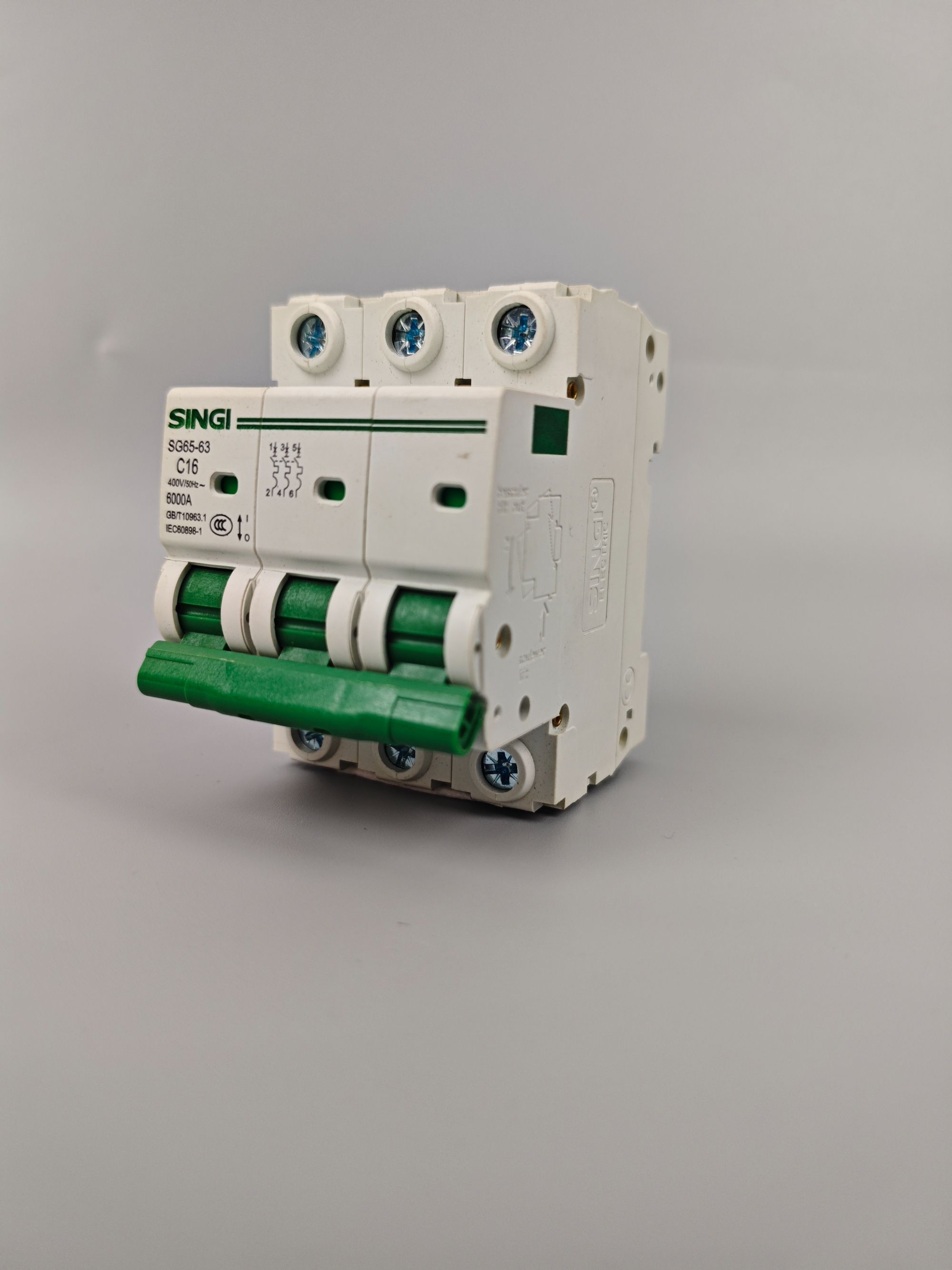
A breaker that survives years of heat, arc erosion, and mechanical shock usually starts with contact alloys that are deliberately overbuilt. Silver-tungsten and silver-tungsten-carbide grades dominate the heavy-duty end because they resist welding and hold their shape long after silver-nickel contacts have started to pit. The tungsten content does more than raise hardness; it creates a porous skeleton that wicks heat away from the arc root and keeps the contact face from developing deep craters. Cheaper designs tend to rely on thinner silver layers or lower tungsten ratios, and the difference shows up as a shorter service life under the same fault duty.
The housing and arc chamber materials matter just as much when the breaker interrupts a real fault. Glass-reinforced thermoset polyester and specialized nylons are common in better units because they stay dimensionally stable when the contact area flashes hot, instead of softening or warping like commodity thermoplastics. Around the arc splitter plates, ceramic arc shields or steel plates with a dull phosphate finish help cool and stretch the arc until it collapses. Inferior breakers often omit those shields or use thinner plates that corrode quickly, which is why two breakers with identical ratings can behave very differently after a few hard trips.
Smaller details separate the genuinely durable designs from the rest. Terminal connections with high copper content reduce resistive heating at the screw lug, while stainless steel springs and riveted rather than spot-welded linkages keep the mechanism crisp over thousands of operations. These choices are rarely visible on a spec sheet, but they determine whether a breaker still trips cleanly after years in a panel or begins to feel loose and inconsistent after a handful of cycles.
Real-World Testing Standards Behind Consistent Trip Performance
The consistency you feel on a daily commute doesn't come from a single spec sheet number. It's the result of running the same route profiles over broken pavement, expansion joints, and wet streetcar tracks until the throttle response and brake feel stop changing between runs. Temperature swings get baked into those sessions, too, from cold-soaked starts to mid-day heat, because a vehicle that behaves differently at 5°C and 30°C isn't ready for real streets.
Test riders of different weights and riding styles repeat the same sequences, often with cargo loaded or on partial battery, to see if the assist curve stays predictable. If a hill climb feels strong at full charge but goes soft at 30 percent, that triggers a recalibration rather than a tweak to the marketing claim. Durability rigs then cycle the frame, suspension, and brake levers far beyond what a normal week would demand so small degradations show up before they become ride-to-ride differences.
The goal of those standards is fairly narrow: a trip should start, accelerate, and stop the same way on a rainy Tuesday as it does on a dry Saturday. When that holds, the rider doesn't have to think about compensating for the machine. That's why much of the testing focuses on repeated mid-ride stops, gentle throttle ramps, and how the system behaves after hours of vibration rather than on headline range figures.
Factory Automation and Its Role in Reducing Defect Rates
On a high-mix electronics line, the difference between a 0.8% defect rate and a 0.3% defect rate rarely comes from operator attention alone. It comes from automated optical inspection stations that compare every solder joint against a learned baseline, paired with pick-and-place machines that flag nozzle wear before misalignment drifts out of tolerance. Instead of relying on end-of-line sampling, the system trends placement offsets in real time and shuts down a station when the moving range exceeds a threshold, keeping a small drift from becoming a batch of bad boards.
The same principle applies beyond electronics. In injection molding, cavity pressure sensors linked to a controller can adjust hold time and packing pressure within milliseconds when viscosity shifts with regrind content or barrel temperature. Operator logs might miss these variations; automation catches them as they happen. The result is fewer short shots, less flash, and a narrower spread around nominal dimensions without increasing cycle time.
What makes this effective is not the removal of people, but the tightening of feedback loops. When defect data is tied to specific tooling, material lots, and machine parameters automatically, engineers can trace a spike in porosity to a worn valve gate rather than guessing from a weekly quality report. Over time, those closed loops raise the baseline, so fewer defects are produced in the first place instead of being sorted out later.
Custom Design Support for Unusual Electrical Loads
Standard power supplies tend to fall short when a load draws current in abrupt, uneven bursts or pushes energy back into the source. Custom design support starts with the actual behavior of the equipment—peak inrush, harmonic content, regeneration, sensitivity to voltage dips—not with a generic wattage rating. That shift in approach makes it possible to address loads that would otherwise force oversized, inefficient, or unreliable solutions.
Engineers map the electrical signature of the load before choosing a topology. For things like pulsed lasers, MRI gradient coils, or motor test benches, the input current may swing from near zero to several times nominal within milliseconds. The design then incorporates active rectification, snubber networks, or fast control loops to keep the supply stable without sacrificing response time. Isolation, EMI filtering, and thermal behavior get treated as part of the same problem rather than as afterthoughts.
Prototypes are exercised against load banks and simulated fault conditions to catch issues that only appear under real operating stress. Adjustments continue through integration, often involving custom firmware limits, revised protection thresholds, or alternative magnetics. The end result is a supply that matches the load it was built for, not the nearest catalog compromise.
After-Sales Service Signals from Long-Standing Production Lines
A line that has run for over a decade rarely fails without warning. The early signs show up in small ways: a slight rise in motor temperature, a change in torque curves, or the same fixture needing adjustment more often than it once did. Operators who have worked alongside the equipment for years tend to notice these shifts long before they appear in a formal maintenance log.
After-sales teams often pick up similar clues through spare part requests and repeat service visits. When the same bearing or sensor is replaced across several machines in one plant, it usually points to a design weak spot or a supplier batch issue rather than ordinary wear. A sudden run on a particular seal after a model has been discontinued can also show that customers are deliberately keeping older lines in service.
Connecting those dots turns service data into something forward-looking. Instead of simply waiting for breakdowns, the team can issue targeted inspection checklists, pre-position slow-moving parts near likely failure points, or adjust refurbishment schedules before field failures multiply. The line itself, through its accumulated quirks and repair history, starts to guide the next move.
FAQ
Look at interrupting capacity and whether the factory can provide third-party test reports, not just a polished catalog. Verify that the products match IEC 60898 or UL 1077 depending on the target market, and ask for sample lots before committing to bulk orders.
Ask about in-house calibration for thermal and magnetic trip units. A factory that can walk you through its bimetal strip sourcing, spot welding process, and endurance test data is usually more dependable than one that only quotes prices.
It depends on the destination. For most of Europe and Asia, IEC 60898-1 compliance with CB test certificates is expected. For North America, UL 489 or UL 1077 listings matter. Ask for certificates that show the factory's name and address, not a trading company's paperwork.
Not necessarily. A 10kA MCB can be ideal for residential panels, while a 6kA unit is enough for many branch circuits. The real quality signal is whether the factory consistently meets the rating it prints on the product and can prove it with type tests.
Many mid-sized factories set trial orders around 500 to 1,000 poles for standard ratings, but some accept smaller mixed orders if you pay a setup fee. It is worth negotiating because a first order tests their flexibility and communication, not just their production line.
Standard stock items often ship in 15 to 30 days, while customized current ratings or special terminals can take 45 to 60 days. A factory that gives a precise schedule with key milestones is usually more organized than one that promises soon or no problem.
Beyond unit price, look at terminal material, silver contact thickness, packaging, and whether the quote includes calibration certificates or export cartons. Cheap quotes sometimes trim costs in the contact alloy or steel plating, which shows up later as overheating or nuisance tripping.
Conclusion
Selecting a miniature circuit breaker factory goes well beyond comparing trip curves on a datasheet. The most dependable suppliers build confidence through materials that can handle repeated fault interruption without contact welding or excessive arc damage. Silver alloy contacts, carefully chosen arc chamber geometries, and high-grade thermoset housings are common among lines that hold up under sustained use. At the same time, production testing separates serious manufacturers from those simply assembling parts. Endurance cycling, short-circuit interruption, temperature rise under load, and vibration exposure reveal whether a breaker will behave consistently when installed in a real panel. Automated assembly and calibration steps also lower the chance of batch-to-batch drift, especially in the precise adjustment of thermal and magnetic trip elements. When a facility integrates these checks into the line rather than relying on final inspection alone, the defect rate tends to stay low even as volume increases.
The strongest factory choices also stand out in how they handle less standard projects. Some electrical loads bring high inrush currents, harmonic content, or tightly grouped circuits that require changes to trip characteristics, terminal arrangements, or mounting profiles. A supplier with an in-house engineering team can adjust designs without treating every request as a special exception. After the sale, long-standing production lines usually signal stronger support because spare parts, technical notes, and replacement knowledge remain available years later. These factories tend to collect field failure data across multiple product generations, which then feeds back into contact materials, calibration routines, and housing improvements. For buyers, that continuity matters as much as a bold spec claim. Reliable electrical protection ultimately comes from a manufacturer that treats breaker performance as an ongoing engineering responsibility rather than a one-time product sale.
Contact Us
Contact Person: Jack
Email: [email protected]
Tel/WhatsApp: (+86) 13757759651
Website: https://www.singi.com