
Travertine Flexible Stone Is Redefining Modern Surface Design
2026-08-19
Nothing says timeless quite like travertine, but its weight and rigidity have always drawn a hard line around where it can be used. Travertine flexible stone erases that line. In this piece, we explore how Magic Stone is redefining modern surface design with a material that bends, wraps, and endures—without sacrificing that timeless stone character.
From Ancient Quarries to Modern Curves: Travertine’s Flexible Reinvention
Long before it became a darling of contemporary design, travertine was hacked from the hillsides of Tivoli and hauled to Rome, where it clad the Colosseum and the colonnades of St. Peter's. Its pitted surface and warm, layered tones spoke of permanence and monumentality, yet the stone itself was surprisingly forgiving to work with. Quarrymen prized its uniform bedding and ability to be split into large, stable blocks without shattering. That ancient workflow—extracting massive slabs, then shaping them with chisels and saws—established a material legacy that modern architects have since turned on its head. Today, the same stone that once demanded straight lines and load-bearing gravity is being sliced thin, bent around curved frameworks, and treated as a flexible skin rather than a rigid mass.
The key to travertine's reinvention lies in its geologic structure. Unlike dense granites or brittle marbles, travertine forms from mineral-rich hot springs, building up in porous, fibrous layers that can be cut and honed to reveal soft, undulating patterns. This porosity, once considered a flaw to be filled with grout, is now celebrated as texture that catches light and shadow across curved surfaces. Fabricators use water-jet cutting, CNC milling, and thin-veneer backing systems to coax the stone into arcs, spirals, and compound curves that would have been unthinkable a century ago. A bar top, a staircase, or an entire facade can now flow continuously in travertine, its natural veining following the geometry rather than fighting it.
What makes this shift more than a technical gimmick is how it reconnects the material to its origins. Ancient travertine was quarried in massive rectangular blocks precisely because the architecture of the time demanded weight and order. Modern curves, by contrast, ask the stone to remember its fluid beginnings—the cascade of a hot spring, the ripple of a mineral shelf. Architects and designers are increasingly drawn to travertine not just for its looks but for this narrative tension: a rock born of water and time, now made to flow again. The result is a quiet rebellion against the straight line, a way of building that feels both ancient and startlingly new.
The Material Alchemy That Turns Brittle Stone into Bendable Sheets
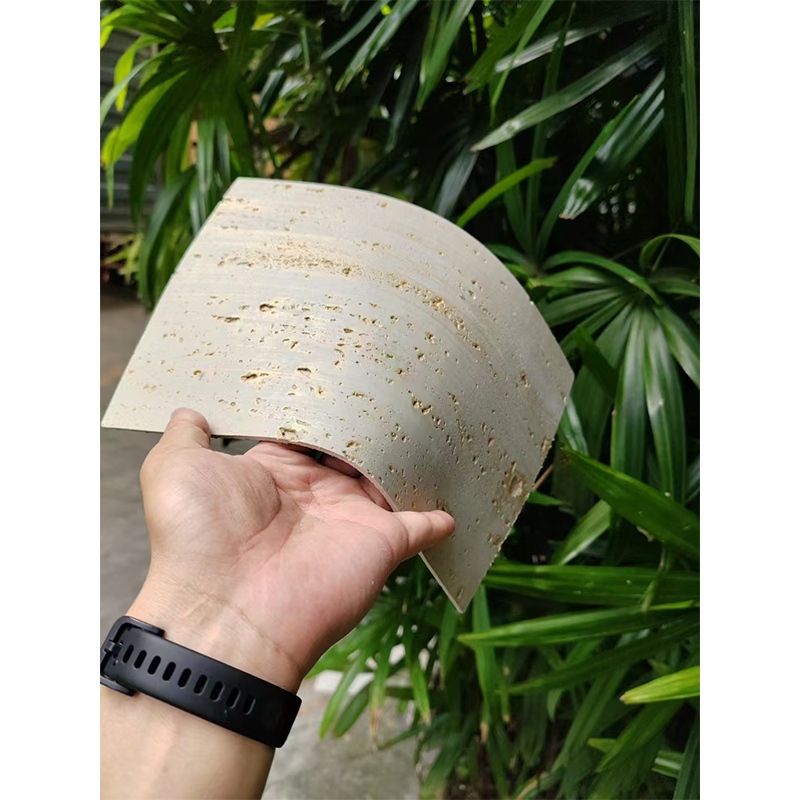
Take a slab of slate or mica-schist, the kind that snaps if you look at it wrong. Now peel it back to a fraction of a millimeter. That's the first trick: not grinding it to powder, but slicing along natural cleavage planes until the stone is thin enough to forget its own weight. What's left is a mineral veneer—still real rock, still flecked with quartz and iron—but now it flexes like thick leather.
The alchemy happens when that fragile layer meets a flexible backing. A polyester resin or fiberglass mesh is bonded to the rear face under pressure, giving the stone a spine it never had. Suddenly a material that once shattered under stress can be wrapped around a column, rolled for shipping, or curved around a bar front. The surface keeps its cold, granular bite; the backing does the forgiving. It's not imitation stone. It's stone with a new set of rules.
How Flexible Travertine Lets Designers Think in Curves, Not Corners
Travertine has long been associated with straight lines and squared-off slabs, but a flexible variant is quietly rewriting that expectation. By slicing the stone into thin layers and bonding them to a flexible backing, manufacturers have created a material that bends without cracking. This opens up a world where walls sweep into gentle arcs, columns wrap in soft curves, and corners lose their dominance in interior layouts.
Designers working with flexible travertine can shape it around rounded reception desks, curved bar fronts, or undulating feature walls that would be impossible with rigid panels. The stone keeps its natural pitted texture and warm beige tones, yet conforms to radiuses as tight as a few inches. Because it remains a genuine stone product, it brings an organic, grounded feel to spaces that might otherwise rely on synthetic alternatives for curved surfaces.
The shift from corner-driven planning to curve-led expression changes how rooms feel. Spaces become more fluid, guiding movement naturally instead of boxing people into angular paths. For architects and interior designers, flexible travertine is not just a material upgrade—it’s a prompt to reconsider geometry itself, to imagine walls that breathe and edges that soften, all while retaining the timeless character of natural stone.
The Weight Factor: Why Thin Stone Panels Are Winning Over Solid Slabs
Thin stone panels shift the math on dead load more than most people expect. A 6mm panel with an aluminum honeycomb backing typically weighs around 15 kg per square meter, while a 30mm solid slab can push past 80 kg. For a mid-rise facade, that difference lets engineers skip costly structural reinforcement and still meet code. Renovation projects benefit even more, since older buildings often cannot carry the extra weight of full-thickness stone without major upgrades.
The savings show up long before installation. Lighter panels mean a flatbed can haul two or three times the square footage per trip, and a two-person crew can lift and position pieces without a crane or vacuum rig. On high-rise jobs, trimming hoist time per panel adds up quickly. It is not just about labor rates; fewer heavy lifts also reduce the chance of strain injuries and jobsite delays.
Weight reduction also pushes stone into places where solid slabs rarely make sense. Thin panels can wrap curved columns, clad elevator lobbies, or run across ceilings without custom anchoring. And because the visible layer is still real stone, designers keep the depth and variation of natural veining while cutting raw material use by up to two-thirds. That combination of lower structural impact and familiar aesthetics is why more spec sheets now default to thin formats.
Tough Yet Pliable: The Surprising Durability of Flexible Travertine
Flexible travertine flips the usual trade-off between strength and flexibility. Instead of cracking under a curve, its stone surface is bonded to a resilient backing that lets it bend around columns, furniture edges, and uneven walls. At the same time, the travertine face remains hard enough to shrug off daily scuffs, scratches, and the occasional dropped object in busy rooms.
That pliability also matters during installation and over time. The material can follow slight movements in a substrate without delaminating or showing hairline fractures, which is a common failure point for rigid stone panels. In bathrooms and kitchens, repeated temperature and humidity shifts don't cause it to warp or lift, so the finish stays steady even after years of use.
What makes the durability feel unexpected is how lightweight and thin the sheets are compared to conventional travertine tiles. You get a natural stone surface that can flex repeatedly yet still resists chipping at the edges and holds its color without extra sealing. It is a practical option for projects that need a curved stone look without the fragility that usually comes with it.
The Resource-Smart Choice: Doing More with Less Stone
Every slab of stone pulled from the earth carries an invisible cost—quarry waste, fuel burned in transport, water used in cutting, and the quiet disappearance of a landscape. The resource-smart approach starts by asking not how much stone a project wants, but how little it actually needs. This flip in thinking turns conventional design on its head: instead of filling walls with thick, uniform cladding, we begin to profile the stone's natural strengths and let those guide where material goes. A thin veneer over a lightweight frame can deliver the same visual weight while using a third of the raw block. The leftover cut-offs, once headed for the dumpster, become mosaic flooring or garden stepping stones. The goal is not austerity—it is precision. By matching stone thickness to structural demand, we stop treating a finite resource as if it were endlessly thick.
Technology quietly enables this shift. Digital templating and CNC water-jet cutting let fabricators nest complex shapes onto a slab with almost no waste. Where a traditional layout might lose 40 percent of the sheet to offcuts, a well-planned digital file can push that number down to single digits. At the same time, better adhesives and anchoring systems mean thinner panels can perform like thicker ones—without cracking, bowing, or losing thermal mass. Quarries themselves are changing too. Some now offer variable-thickness slabs, allowing designers to specify a 2 cm surface where it shows and a 1 cm backing where it hides. This is not a compromise in beauty or durability; it is simply using less material per square meter without asking the stone to do less work.
Practically, resource-smart stone is a conversation between the quarry, the fabricator, and the architect. It starts with selecting stone from regional sources to cut transport emissions, then moves to designing for standard slab sizes to avoid unnecessary cuts. On site, masons trained in thin-bed mortar and dry-stack methods can build with half the stone thickness a traditional wet-set wall would demand. The result is a project that feels grounded and solid but leaves behind a lighter footprint—both in the quarry and in the carbon ledger. Doing more with less stone is not about cheapness; it is about respecting the material enough to use every millimeter intelligently.
FAQ
It is engineered as a thin, bendable veneer that can wrap around curves and irregular surfaces without cracking. Standard travertine is rigid and much heavier, so it typically stays on flat walls and floors.
Yes, once sealed it resists moisture and staining. It works well for backsplashes, shower walls, and vanity surrounds, provided the substrate is properly waterproofed and the edges are sealed.
It brings the warmth of natural stone into clean-lined spaces without the bulk. Designers use it to create continuous stone surfaces across curved walls, arched openings, and custom furniture where rigid panels would look awkward.
In many ways it is easier. The lightweight sheets can be cut with a utility knife and adhered with standard polymer-modified thin-set. The key is starting with a smooth, stable substrate to prevent imperfections from showing through.
Routine dusting and occasional wiping with a pH-neutral stone cleaner are enough for daily care. A penetrating sealer should be reapplied every one to two years, and abrasive pads or acidic cleaners should be avoided.
Organic modern, Japandi, and warm minimalist interiors gain the most. The soft texture and subtle beige tones pair naturally with limewash plaster, light oak, and matte black fixtures, helping to avoid a cold or sterile feel.
Some exterior-grade versions are rated for temperature swings and UV exposure, but not all are. You need to check the product's freeze-thaw resistance and pair it with an exterior-rated adhesive and sealant.
The stone surface resists scratches and wear similarly to solid travertine, but the backing is more sensitive to impact and heavy loads. For vertical surfaces and light-use areas it holds up well, while floors and high-traffic zones need extra caution.
Conclusion
Travertine has long carried a sense of age and warmth, but until recently its weight and brittleness kept it confined to flat floors and hefty slabs. The flexible reinvention changes that by slicing the stone into remarkably thin, bendable sheets that can wrap around columns, flow across curved partitions, and follow the sweep of an arched ceiling without demanding heavy structural support. It feels less like a compromise and more like a quiet kind of alchemy—stone that bends like thick fabric while holding onto its natural pits, veins, and sun-washed tones. Designers no longer have to choose between the character of real travertine and the freedom of a curved surface.
The benefits go well beyond silhouette. Thin stone panels weigh a fraction of solid slabs, so transport and installation become faster and less expensive, yet the material remains surprisingly resilient—flexing under stress and resisting cracks in busy interiors or exterior cladding. Because each square meter uses far less raw rock, the approach also stretches quarry yields and reduces waste, making it appealing for projects that care about resources without wanting to give up a tactile, natural finish. As more architects and interior designers realize they can sketch curves without corners and still specify genuine travertine, the material is quietly moving from a nostalgic flooring option into a versatile, forward-looking surface for walls, furniture, and facades.
Contact Us
Contact Person: Vito
Email: [email protected]
Tel/WhatsApp: 86 13088879266
Website: https://www.magicstonemcm.com